

Huawei pivots from storage vendor to AI infrastructure provider amid enterprise AI shift
- Details
- Category: Vendors
- 10565 views
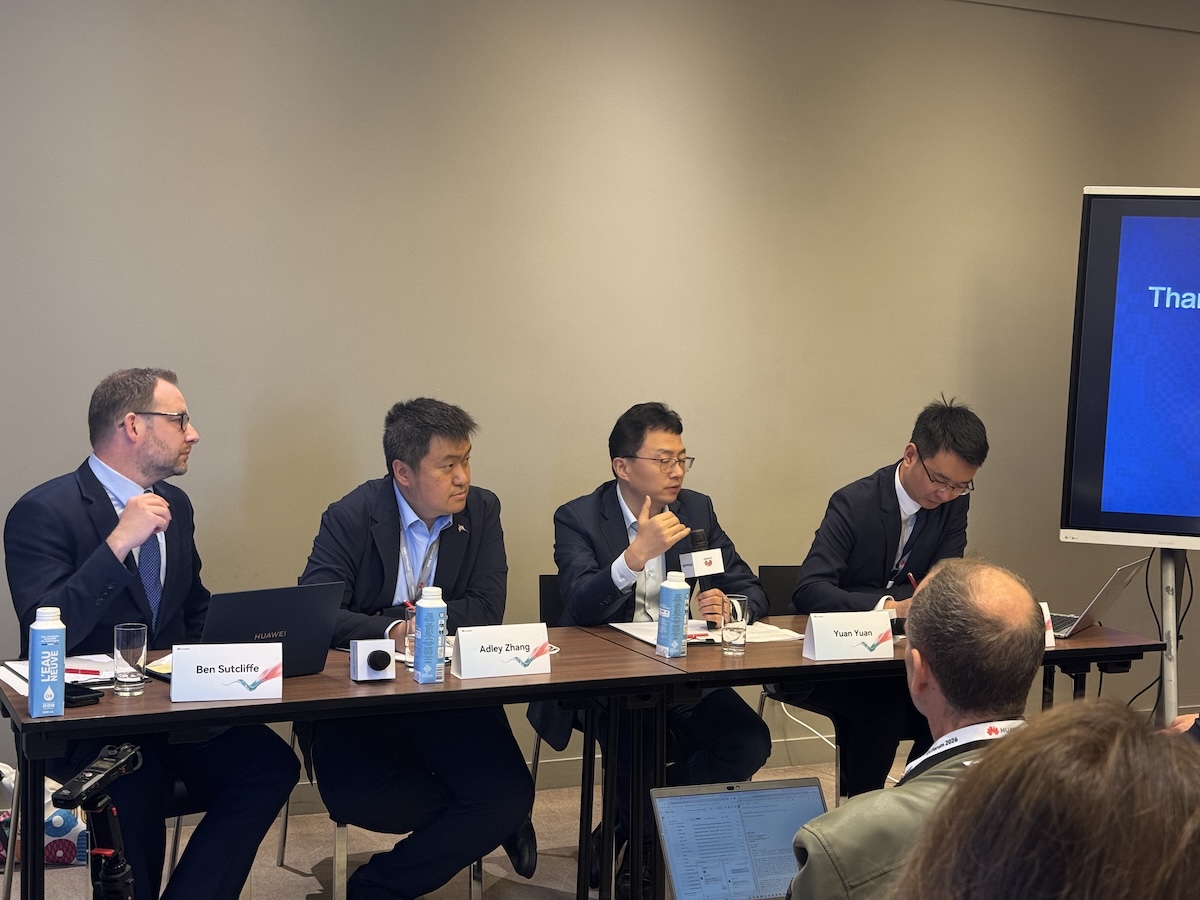
Huawei executives said the company is repositioning itself from a traditional storage hardware supplier into a provider of full-stack AI data infrastructure, arguing enterprises will need to overhaul existing architectures to cope with the rapid rise of AI workloads.
Speaking during a media briefing at the Huawei Innovative Data Infrastructure (IDI) Forum 2026 in Paris, Yuan Yuan (pictured, third) Vice President of Huawei and President of the Huawei Data Storage Product Line, described AI as a “big shift” not only for the industry but also for Huawei itself.
“We ended up changing our shift from the traditional data storage equipment manufacturers to the AI data infrastructure providers,” Yuan said. “Our purpose is to transfer our business and architectures in the several years to fixing the AI requirements from our customer side.”
The comments came as Huawei formally unveiled a new full-stack data infrastructure portfolio for AI data centres, designed to support large-scale enterprise AI deployments.
Huawei’s launch includes AI data lake infrastructure, model engineering tools, agent frameworks and data resilience systems, alongside new storage products aimed at handling increasingly data-intensive AI workloads.
In the keynote announcement earlier in the day, Huawei said enterprises must evolve existing IT systems into AI-ready infrastructure built around data lakes, AI platforms, compute resources and resilient storage architectures.
The company highlighted several new offerings, including its OceanStor Pacific scale-out storage platform, which it claims can deliver 11PB of capacity in a 2U chassis, and a new Context Memory Storage (CMS) platform designed for ultra-scale inference clusters. Huawei said the CMS platform can reduce time-to-first-token latency by 90%.
European enterprises cautious about AI migration
Executives at the press conference repeatedly stressed that enterprise AI adoption is still in its early stages, particularly in Europe, where customers remain cautious about replacing existing infrastructure.
Yuan, who previously lived in Europe for eight years, said many customers are reluctant to abandon current systems and instead want gradual AI upgrades.
“European customers want to protect the investment,” he said. “They always ask, can they reuse our equipment?”
Huawei is therefore offering two migration approaches: greenfield AI infrastructure deployments for customers with sufficient budgets, and layered upgrade models allowing enterprises to retrofit AI capabilities onto existing storage environments.
Yuan pointed to Huawei’s “AI digital engine” layer, which can be added onto existing storage arrays to support AI workloads while preserving legacy infrastructure for traditional enterprise applications such as Oracle databases and virtual machines.
Huawei bets on hybrid and on-premise AI deployments
Despite the growing attention around public cloud AI services, Huawei executives argued on-premise infrastructure will remain critical for sectors handling sensitive or regulated data.
“As the hardware manufacturers, we hold a very optimistic view to the on-premise construction,” Yuan said.
While enterprises may initially experiment with AI services in public clouds, sectors including healthcare, manufacturing and government would eventually need local AI infrastructure because of data privacy and sovereignty concerns, he added.
The issue of data sovereignty emerged repeatedly during the session, particularly from European journalists concerned about dependence on US cloud providers.
Yuan acknowledged a growing trend among enterprises seeking alternatives to hyperscale cloud providers.
“Customers don’t want to put every egg in one basket,” he said, adding that Huawei is positioning its AI-ready infrastructure both for enterprises and local cloud operators building multi-tenant AI services.
Focus on lowering AI infrastructure costs
Executives also said telecom operators and enterprises are increasingly focused on reducing the cost and power consumption of storage infrastructure as AI drives rapid growth in data volumes.
Jeff Wu, Chief Marketing Officer of Huawei’s Data Storage Product Line, said Huawei is using AI-based workload optimisation and data reduction technologies to lower total cost of ownership.
“We could offer five-to-one data reduction ratio,” Wu said. “If you have five petabytes of data, it could store to the storage as only one petabyte.”
Huawei is also using AI to dynamically adjust CPU operating frequencies within storage systems to reduce power consumption during periods of lower utilisation.
Alongside AI infrastructure, Huawei highlighted virtualization and resilience as key strategic priorities, particularly as enterprises reassess existing virtualisation platforms.
Wu described Huawei’s full-stack data centre solution as a major focus area, saying customers across manufacturing, banking and government sectors are increasingly looking for alternative infrastructure solutions.
AI agents and automation become strategic priorities
The company also placed significant emphasis on AI operations tools and agent technologies.
Yuan revealed Huawei is already developing AI agents for infrastructure management tasks such as hardware fault prediction, health monitoring and maintenance automation.
One AI “copilot” agent is designed to assist administrators with routine management operations and reduce operational complexity, while other agents are being developed through Huawei’s Nexent platform to interoperate with third-party systems.
However, Huawei executives were more cautious when discussing explainable AI.
Asked whether Huawei’s AI agents support explainable AI capabilities, Yuan argued the field remains largely experimental.
“I don’t think now AI can be explainable,” he said. “It’s not mathematics, it’s kind of statistics and experiences.”
He added that research into explainable AI remains primarily within academia rather than commercial deployments.
Huawei says AI demand remains difficult to predict
Huawei executives also acknowledged the uncertainty surrounding AI market demand and future product requirements.
“The biggest challenge is requirements,” Yuan said. “Customers cannot lead us anymore. Sometimes they don’t know what they need in AI.”
He warned that AI infrastructure vendors now face the risk of making incorrect technology bets as the market develops, forcing suppliers to rely more heavily on internal predictions rather than customer-driven roadmaps.
“Maybe we can move and make wrong investment,” he said. “But we have to gradually step by step.”
More Articles you may be Interested in...


Huawei to support Equatorial Guinea’s comms upgrade

Huawei and rain claim sub-1GHz breakthrough






Huawei proposes alternative to Moore’s Law


